

Introduction
Ovarian cysts are one of the most common gynaecological findings and one of the most misunderstood. Many women discover they have a cyst not because something felt wrong, but because a routine scan picked it up. The word “cyst” alone can trigger anxiety, but in most cases, the clinical picture is far less alarming than it sounds.
Understanding what ovarian cysts are, what causes them, and when they actually need treatment helps women make informed decisions about their health without unnecessary fear or unnecessary delay. This article covers the full picture: from basic anatomy to surgical options, fertility considerations, and practical prevention tips.
What Is an Ovarian Cyst?

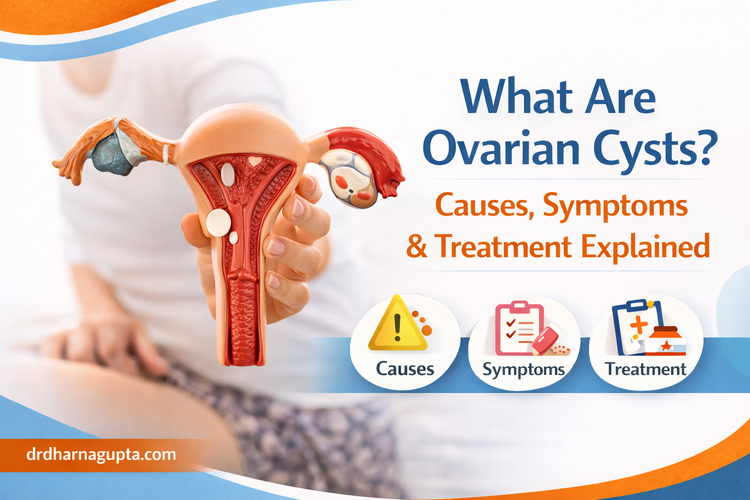
An ovarian cyst is a fluid-filled or semi-solid sac that develops on or inside one of the ovaries. The ovaries are two small organs, one on each side of the uterus, responsible for producing eggs and the hormones oestrogen and progesterone.
Cysts form when a normal biological process goes slightly off course or when an abnormal growth develops within the ovary. The vast majority are benign, cause no lasting harm, and resolve without any medical intervention. A small subset persist, grow, or develop features that require clinical attention.
What Causes Ovarian Cysts?
Several distinct mechanisms lead to ovarian cyst formation. The cause determines the type of cyst, which in turn guides how it should be managed.
Hormonal Imbalance
The menstrual cycle depends on a precise hormonal sequence involving FSH (follicle-stimulating hormone) and LH (luteinising hormone). When this sequence breaks down, follicles either fail to release an egg or fail to dissolve after ovulation and a cyst forms in their place. Hormonal imbalance is the most common driver of cyst formation in women of reproductive age.
Ovulation-Related Causes
Two types of cysts arise directly from the ovulation process:
- Follicular cysts: A follicle grows to maturity but does not rupture to release an egg. Instead, it continues to enlarge. These are the most common types of ovarian cysts and almost always resolve on their own within a few weeks.
- Corpus luteum cysts: After ovulation, the follicle normally transforms into the corpus luteum, which produces progesterone. If it seals shut and fills with fluid, a corpus luteum cyst develops. These can occasionally bleed internally and cause sudden, sharp pelvic pain.
Endometriosis
In endometriosis, tissue similar to the uterine lining grows outside the uterus, including on the ovaries. When this tissue bleeds during menstruation, the blood pools and forms a cyst called an endometrioma, commonly known as a chocolate cyst because of its dark, old-blood content. Unlike functional cysts, endometriomas do not resolve on their own and typically require surgical treatment.
Polycystic Ovary Syndrome (PCOS)
PCOS is a hormonal disorder in which the ovaries produce excess androgens. Multiple small, immature follicles develop, but none reach full maturity; these appear as tiny cyst-like structures on ultrasound. It is worth noting that PCOS is a hormonal condition, not a cyst disease. The “cysts” visible on scan are undeveloped follicles, not true pathological cysts. However, PCOS does increase the risk of genuine cyst formation due to its effect on ovulation.
Pregnancy-Related Cysts
During early pregnancy, the corpus luteum produces progesterone to support the developing embryo. This process sometimes leads to corpus luteum cyst formation. These cysts are almost always benign and transient, typically resolving by the second trimester as the placenta takes over hormone production.
Common Symptoms of Ovarian Cysts
Many ovarian cysts produce no symptoms at all they are found incidentally during a pelvic scan done for another reason entirely. When symptoms do occur, they usually include:
Pelvic Pain
A dull, aching sensation on one side of the lower abdomen is the most commonly reported symptom. The pain can be continuous or intermittent. A sudden, severe, sharp pain, particularly if accompanied by fever, vomiting, or dizziness, may indicate cyst rupture or ovarian torsion. Both are medical emergencies that need immediate attention.
Bloating and Abdominal Fullness
Larger cysts press on surrounding structures and produce a sensation of fullness, heaviness, or visible abdominal swelling. Some women feel full quickly when eating or experience persistent pressure in the lower abdomen throughout the day.
Irregular Periods
Cysts that disrupt the ovary’s hormonal function can cause menstrual cycles to become irregular, heavier, lighter, or unpredictable. This is particularly common in women with functional cysts or PCOS.
Pain During Intercourse
Deep pain during sexual intercourse, particularly in certain positions, can occur when a cyst sits in a location where it experiences pressure. This symptom, known as dyspareunia, warrants clinical evaluation regardless of suspected cause.
What Size of Ovarian Cyst Is Dangerous?
Is a 4 cm ovarian cyst big?
Size is one factor in assessing an ovarian cyst but not the only one. Gynaecologists also consider cyst type, imaging characteristics, the patient’s age, symptoms, and menopausal status. Here is how cyst size generally informs clinical decisions:
| Small (under 3 cm)Most functional cysts fall in this range. Watchful waiting with a follow-up ultrasound in 6–8 weeks is standard. These almost always resolve within one to two menstrual cycles. |
| Moderate (3–5 cm)A 4 cm cyst is not automatically dangerous. A simple, purely fluid-filled cyst of this size in a woman of reproductive age is very likely to resolve without intervention. Complex features, solid components, thick walls, or internal echoes change that assessment. |
| Large (5–10 cm)Closer follow-up is warranted. Surgical evaluation becomes relevant if the cyst persists, grows, or shows complex features on imaging. |
| Very large (over 10 cm)Surgical consultation is appropriate regardless of symptom status. Cysts above 10 cm carry a higher risk of ovarian torsion, where the ovary twists on its own blood supply and needs timely evaluation. |
Size alone does not determine the level of danger. Type, imaging features, and the patient’s clinical context always factor into the management plan.
Diagnosis and Imaging Findings
What are internal echoes in an ovarian cyst?
Pelvic ultrasound is the primary tool for diagnosing and characterising ovarian cysts. Ultrasound reports often include terminology that can feel unfamiliar. Here is what the common findings mean in plain terms:
- Simple cyst: A purely fluid-filled cyst with smooth walls and no internal echoes. This is the most reassuring finding. Simple cysts in women of reproductive age are almost always benign.
- Internal echoes: The ultrasound picks up reflections from material inside the cyst old blood, protein-rich fluid, or cellular debris. An endometrioma, for example, shows characteristic low-level internal echoes from old blood. Internal echoes indicate that the cyst contains more than clear fluid; they do not automatically indicate malignancy, but they do prompt further assessment.
- Septations: Thin internal walls or partitions within the cyst. Thin, smooth septations are generally benign. Thick or irregular septations raise more concern and may warrant additional investigation.
- Solid components: Areas of solid tissue within an otherwise fluid-filled cyst. Complex cysts with solid components, particularly in postmenopausal women, need further evaluation, which may include a CA-125 blood test and specialist referral.
Ultrasound findings always need to be interpreted alongside the patient’s age, menstrual status, and clinical symptoms. No single imaging feature determines the management plan in isolation.
Can Ovarian Cysts Affect Pregnancy and Fertility?
This is one of the most common concerns women bring to gynaecology consultations. The answers depend on the type of cyst and what is driving it.
Can an ovarian cyst affect pregnancy?
Most ovarian cysts do not affect an ongoing pregnancy. Corpus luteum cysts, which are common in early pregnancy, actually support the pregnancy by producing progesterone; they are a normal feature of early gestation. They typically resolve by weeks 12 to 14. Occasionally, a large cyst causes discomfort as the uterus grows, and in rare cases, it may require surgical removal during the second trimester if ovarian torsion becomes a risk.
Can an ovarian cyst prevent pregnancy?
A simple functional cyst does not prevent pregnancy. However, conditions that cause cysts, primarily endometriosis and PCOS, can interfere with fertility. Endometriosis creates adhesions and damages ovarian tissue, reducing egg quality and ovarian reserve. PCOS disrupts ovulation, making fertilization less likely without targeted treatment.
Can an ovarian cyst cause infertility?
A benign functional cyst on its own does not cause infertility. Endometriomas are a more serious concern, as they directly damage ovarian reserve over time, and women with endometriomas who plan to conceive benefit from timely clinical advice about management timing. PCOS affects ovulation and requires treatment, but most women with PCOS do achieve pregnancy with appropriate medical support.
How to get pregnant with ovarian cysts?
The approach depends entirely on the underlying cause. For women with PCOS, ovulation induction using medications such as letrozole or clomiphene alongside lifestyle changes that improve insulin sensitivity and hormonal balance forms the core of fertility treatment. For women with endometriomas, the gynaecologist evaluates whether surgical treatment before conception attempts is advisable, or whether moving directly to assisted reproduction is the better option. For women with simple functional cysts, conception attempts need not wait the cyst itself is not a barrier to getting pregnant.
Sexual Health and Ovarian Cysts
Can you have intercourse with an ovarian cyst?
In most cases, yes. A small, asymptomatic functional cyst does not require avoiding sexual activity. The important thing is to pay attention to what the body signals.
Intercourse is best avoided when:
- There is sharp or significant pelvic pain during or after sex
- A recently diagnosed large cyst (over 5 cm) has not yet been assessed by a doctor
- There are symptoms that suggest cyst rupture sudden severe pain, dizziness, nausea, or shoulder tip pain
Deep dyspareunia pain with deep penetration in women with suspected endometriosis deserves proper gynaecological evaluation, not just positional adjustments. Adjusting position may reduce discomfort temporarily, but it does not address the underlying condition.
Treatment Options for Ovarian Cysts
Treatment decisions depend on the cyst type, size, imaging features, the patient’s symptoms, age, and reproductive goals. Not every ovarian cyst needs active treatment.
Watchful Waiting
For most simple functional cysts in reproductive-age women, watchful waiting is the appropriate first step. A repeat ultrasound after 6 to 8 weeks confirms whether the cyst has resolved. The majority of functional cysts disappear within one to three menstrual cycles without any intervention. This approach works best for cysts under 5 cm with no suspicious features and no significant symptoms.
Medications
Combined oral contraceptive pills do not shrink existing cysts, but gynaecologists sometimes prescribe them to prevent new functional cysts from recurring in women who experience them repeatedly. For PCOS, medications help regulate the menstrual cycle and support ovulation. For endometriosis, hormonal suppression, including GnRH agonists or progesterone-based treatments, can reduce endometrioma activity and pain before surgery, or in cases where surgery is not immediately appropriate.
Surgical Removal
Surgery becomes the recommended path when a cyst is large (typically over 7 to 10 cm), persists beyond three to six months of observation, shows complex features on imaging, causes significant symptoms, or carries a meaningful risk of malignancy. The standard approach is laparoscopic cystectomy keyhole surgery that removes the cyst while preserving the ovary. In cases where the ovary cannot be preserved, oophorectomy (removal of the ovary) may be necessary. Preserving ovarian tissue is a priority, particularly for women who have not completed their families.
Life After Treatment
Will removing an ovarian cyst cause weight loss?
This depends primarily on cyst size. Removing a small to moderately sized cyst will not produce measurable weight loss; the fluid volume is simply too small to register on a scale. A very large cyst, one containing several litres of fluid, can result in a visible reduction in abdominal girth and body weight after removal. Most women notice a reduction in bloating and abdominal pressure after surgery, which makes a real difference to how they feel and how clothes fit, even if the scale does not change dramatically.
How soon after ovarian cyst removal can a woman get pregnant?
Most gynaecologists advise waiting one to three full menstrual cycles after laparoscopic cystectomy before attempting to conceive. This gives the ovary time to recover and ensures the reproductive environment is optimal. The exact timeline varies depending on the extent of surgery, whether both ovaries were involved, and the underlying condition that caused the cyst. A post-operative consultation with the treating gynaecologist provides personalised guidance based on the individual case.
How to Prevent Ovarian Cysts
Not all ovarian cysts are preventable. Functional cysts form as part of the normal menstrual cycle and cannot always be avoided. What can be done is to reduce the risk of recurrence and catch cysts early through regular monitoring.
Lifestyle and Hormonal Balance
- Maintain a healthy body weight. Excess adipose tissue produces oestrogen, which can disrupt the hormonal balance that drives functional cyst formation, particularly relevant for women with PCOS.
- Exercise regularly. Physical activity improves insulin sensitivity and supports hormonal regulation, both of which reduce cyst recurrence risk in women with PCOS.
- Manage chronic stress. Sustained high cortisol levels interfere with the hormonal signalling that governs ovulation, which can contribute to abnormal follicle development.
- Investigate irregular periods. Conditions like hypothyroidism and insulin resistance disrupt normal follicle development and increase cyst risk. These conditions are treatable; leaving them undiagnosed helps no one.
Regular Gynaecological Checkups
Women with a history of ovarian cysts, PCOS, or endometriosis benefit from regular gynaecological reviews, including pelvic ultrasound when indicated. Early detection of a developing cyst before it grows large or causes complications makes management significantly simpler and outcomes significantly better.
When Should You See a Doctor?
Do not wait for symptoms to become severe before seeking a consultation. Book an appointment with a gynaecologist if any of the following apply:
- Persistent pelvic pain or pressure lasting more than a few days
- Painful periods that worsen over time
- Pain during sexual intercourse
- Irregular or missed periods without a known cause
- Increased urinary frequency or difficulty emptying the bladder
- Unexplained bloating that does not resolve with dietary changes
| Go to the emergency department immediately if:Sudden, severe pelvic or abdominal pain occurs, especially with fever, vomiting, dizziness, or shoulder tip pain. These symptoms can indicate cyst rupture or ovarian torsion, both of which are time-sensitive emergencies. Do not wait for a scheduled appointment. |
Latest Blog What Should You Know Before Laparoscopic Surgery?
Conclusion:
Ovarian cysts are a routine part of gynaecological practice common, often harmless, and in most cases self-resolving. The important thing is not to let fear of a diagnosis lead to either panic or avoidance. Both extremes can cause harm.
Knowing the type of cyst, understanding what the imaging shows, and having a clear management plan from a gynaecologist is what turns a confusing diagnosis into something manageable. When caught early and monitored appropriately, the vast majority of ovarian cysts cause no lasting impact on health, fertility, or quality of life.
If something feels off, whether that is pelvic pain, irregular cycles, or discomfort during sex, get it checked. Early evaluation is always the right call.
For those looking for experienced care, consulting a specialist like Dr Dharna Gupta, who focuses on evidence-based and patient-centred gynaecological treatment, can help you get clear answers and the right guidance without unnecessary stress.
FAQs (Quick Answers)
Q: Are ovarian cysts cancerous?
A: The overwhelming majority of ovarian cysts are benign. Complex cysts in postmenopausal women require closer evaluation, but even then, most prove non-cancerous. The gynaecologist assesses risk based on imaging features, CA-125 levels, and the patient’s clinical profile.
Q: Can a cyst come back after removal?
A: Yes, particularly in women with endometriosis or PCOS. Removing the cyst treats the immediate problem; treating the underlying condition reduces the risk of recurrence. This distinction matters when planning long-term management.
Q: Do ovarian cysts always cause symptoms?
A: No. Many cysts produce no symptoms and are found incidentally on ultrasound. Symptoms tend to develop when a cyst is large, ruptures, or causes ovarian torsion.
Q: Can a woman get pregnant with PCOS?
A: Yes. Women with PCOS can and do conceive. Many benefit from medical support to stimulate ovulation, but pregnancy is achievable for the vast majority with the right treatment approach.
Q: How long does it take for a functional cyst to go away?
A: Most functional cysts resolve within one to three menstrual cycles, roughly four to twelve weeks. A follow-up ultrasound confirms resolution.
Q: Is laparoscopic surgery for ovarian cysts safe?
A: Laparoscopic cystectomy is a well-established, minimally invasive procedure with a low complication rate. Most women return to normal activity within one to two weeks of surgery.
Q: Can lifestyle changes alone manage PCOS-related cysts?
A: Lifestyle changes, particularly weight management and regular exercise, can significantly improve hormonal balance in PCOS and reduce cyst recurrence. For women trying to conceive, ovulation induction medication is usually also required alongside lifestyle changes.
Click here – How to Choose the Right Gynecologist Hospital


